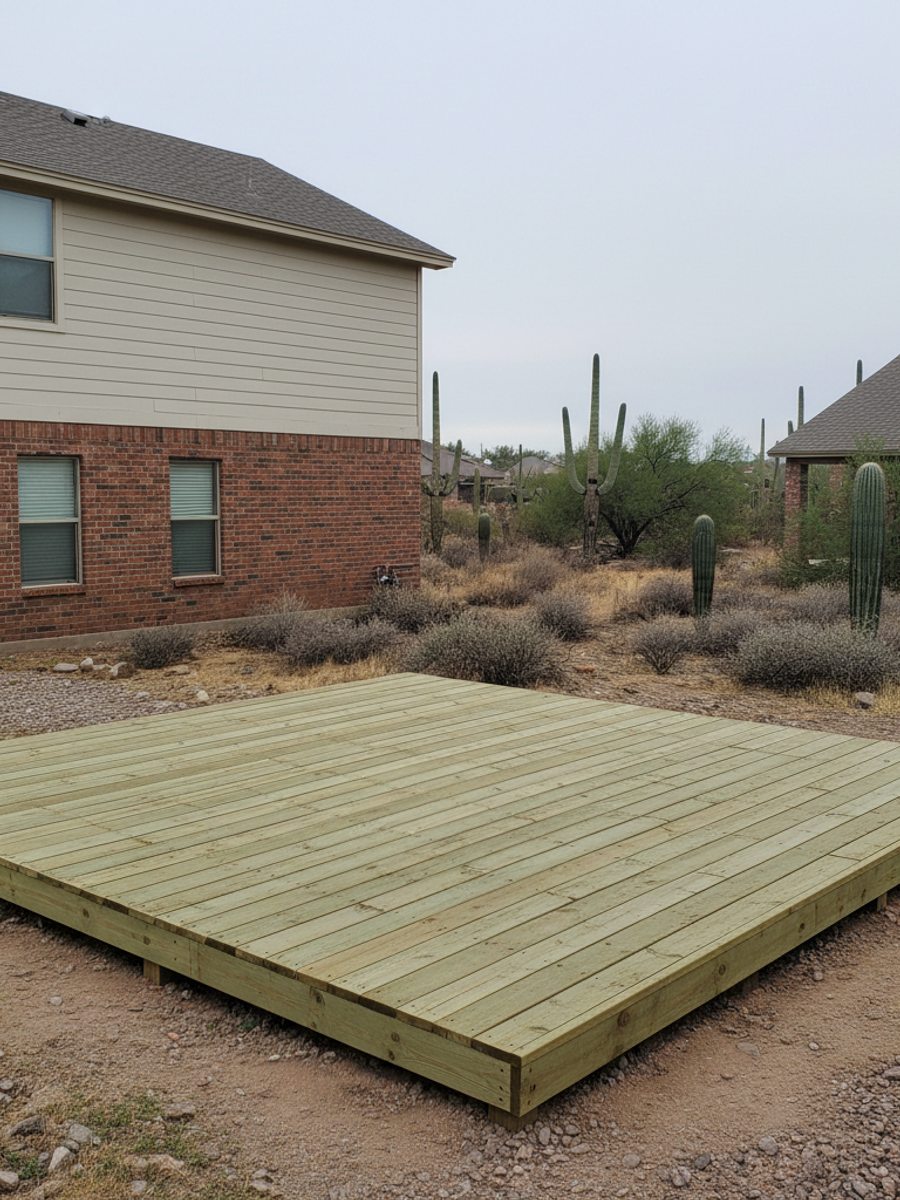
Anyone can put up a deck. Not everyone can put one up that survives its first Phoenix summer without the boards cupping or the ledger bolt rusting through. This is a trade where the local ground and the local heat matter as much as the carpentry, so the questions you ask a builder should reflect that.
The ground here isn't what most builders trained on
A lot of the Valley sits on caliche, a hard, cemented layer of soil that can start six inches down or six feet down depending on where you are. It's dense enough to be a pain to dig through with a hand auger, and it behaves very differently under a footing than the sandy loam or clay a deck builder from somewhere wetter might expect. A footing that's deep enough in Ohio can sit on unstable fill here if the crew didn't hit real bearing soil. Ask how deep they're going and whether they've hit caliche on the site before, or whether they're planning to power auger through it. If a builder can't tell you the difference between digging into caliche and digging into ordinary dirt, that's a sign they haven't built many decks here.
In parts of Ahwatukee, Anthem and some of the newer west valley subdivisions, you'll also find engineered fill from grading work, which needs its own attention. In older neighborhoods like Arcadia, Encanto and Coronado, expect to find old buried footings, irrigation lines, or a patio slab poured decades ago that the new structure has to work around, not on top of.
Permits and inspections aren't optional here, and skipping them costs you later
Most attached decks in the City of Phoenix need a building permit, and if your property is in unincorporated Maricopa County it goes through the county instead. Either way, expect at least two inspections: one after the footings are dug and before concrete goes in, and one at the framing stage before any decking boards go down. A builder who tells you permits aren't necessary for a deck like yours is either wrong or hoping you won't check. Unpermitted decks show up as a problem at resale, when the buyer's inspector or the title company asks for permit records that don't exist.
If you're in an HOA neighborhood, and a good number of newer Phoenix-area communities are, you'll usually need architectural approval before the permit even gets submitted. That can add a couple of weeks. A builder who's worked in Verrado or Anthem before will already know the drill; one who hasn't may not budget the time for it.
What Phoenix heat does to the structure, and what a good builder does about it
We get well over a hundred days a year above 100°F, and that heat doesn't just make the deck uncomfortable to stand on barefoot. It moves wood. Pressure-treated pine, if it's not properly kiln-dried after treatment, will shrink and check as it dries out in the sun, opening gaps that weren't there at install. Composite boards expand and contract more than most homeowners expect, which is why manufacturers specify a gap between boards, usually somewhere around a quarter inch depending on the product, and why that gap has to be respected at the ends and around posts too. If a builder butts composite boards tight with no gap, you'll see buckling within a season.
The ledger board, the piece bolted to your house that the whole deck often hangs from, is the single most common failure point in this climate and every other one. It needs flashing to keep water out from behind it, and the bolts should be corrosion-resistant, hot-dip galvanized or stainless, not whatever was in the truck. Ask what they're using for ledger attachment. If the answer is vague, keep asking.
Monsoon season changes what "finished" needs to mean
July through September brings sudden, heavy downpours here, sometimes an inch of rain in under an hour after months of nothing. A deck surface needs a slight slope, usually a couple of percent, away from the house so water sheds instead of pooling against the ledger or running back toward the foundation. This matters more on a deck than most homeowners assume, because a flat deck surface next to a stucco wall is exactly where water finds its way in over a few years. Ask how they're handling drainage and slope, not just what the decking material will be.
Questions worth asking, and answers worth walking away from
- Ask for the license number and current insurance, both general liability and workers' comp. Walk away from anyone who won't produce either, or who says a helper is "basically an employee" without being covered.
- Ask for a written scope with material specs, not just "pressure-treated lumber" but sizes, fastener type, and whether it's hidden-fastener or face-screwed. A one-page handshake estimate is a red flag on a project this size.
- Ask about railing code. Guardrails on a raised deck generally need to be 36 to 42 inches high depending on the jurisdiction, and baluster spacing has to keep a 4-inch sphere from passing through. This is a life-safety detail, not a style choice, and a builder who shrugs it off doesn't know the code or doesn't care.
- Walk away from full payment up front. A deposit is normal. The full contract price before any lumber is delivered is not.
- Walk away if they won't tell you who's pulling the permit. Either they are, or you are, and both of you need to know which.
The honest limits of what to expect
Even a well-built deck in this climate needs upkeep. Wood decking should get resealed roughly every one to two years here, more often on a south-facing deck that takes full sun most of the day, because UV breaks down the sealer faster than it would somewhere with less sun exposure. Composite doesn't need staining, but it still gets hot enough in July that some homeowners regret choosing a dark color once they feel it underfoot. A builder who's honest about that trade-off, instead of just selling you the color you like, is worth more than one who tells you everything will be maintenance-free.
We've built and repaired decks across the Phoenix area long enough to know where the caliche usually sits and how a ledger board fails first. If you're weighing bids right now, ask the questions above before you sign anything, and take a look at our deck builder work if you want to see how we handle these details ourselves.